


Regatta, 1931 (courtesy of Beccles and District Museum)
Beccles was a river port in the Anglo-Saxon period, as its annual payment of 30,000 herring to the Abbey of St Edmund in the time of Edward the Confessor suggests strongly that fish caught off the coast were brought to Beccles in substantial numbers.
The Quay was begun in 1832, being referred to as a large public wharf. The Norwich Mercury of 24th November that year stated: ‘Beccles may be ranked among the principal ports of inland navigation.’ Typical imports in the 1830s were coal from Newcastle and timber from London; common exports were ale, grain and malt to London. A more unusual import was ‘best Bangor slates’ unloaded at ‘the Timber Yard, New Quay, Beccles’. The remains of shipwrecked vessels were brought to the timber yard for sale.
Before the Quay was created, private staithes or wharves existed along the river frontage, such as that of Sam Lillistone in Northgate. Today on the Northgate side of premises called The Staithe, once the location of Lillistone’s wharf, can be seen the name of the firm of Smith and Eastaugh, which traded from there in the late Victorian period until the 1930s. Common staithes also existed.
Barges and keels, both relatively small, were used before the larger trading wherry developed. The black-sailed wherry had its heyday in the 19th and early 20th century. Pigot’s Directory of 1830 recorded that wherries sailed every day to Bungay from Beccles. To Yarmouth they sailed twice a week. The timber and brick-making business of the Darby family, whose wharf lay on the Norfolk side of the river near the bridge, used wherries extensively, as did the producers of flour and malt
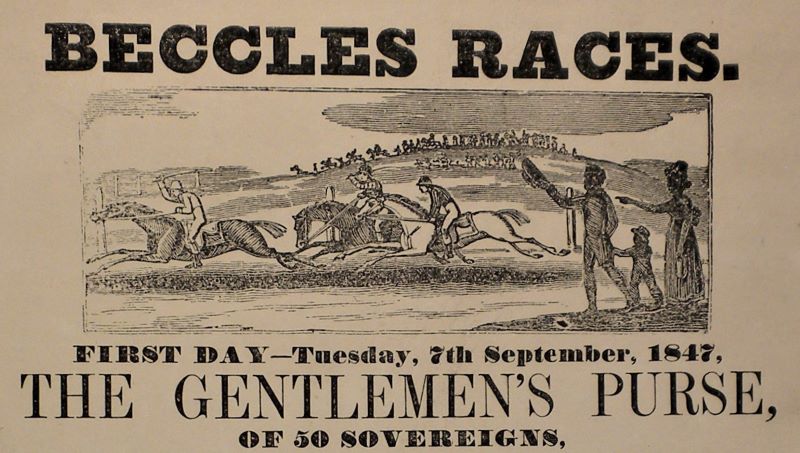
Beccles Races, 1847 (Rix Collection, courtesy of Beccles Town Council
The royal charter of 1584 established a council of 12 senior (‘the principal and more discreet men’ of Beccles) and 24 junior members (described as ‘honest and fit’) who drew up rules for the management of the marshes. Any man chosen to be a council member could be imprisoned or fined until he agreed to serve!
The rules came to include the number of ‘great beasts’ (horses and cattle over a year old), pigs and geese that residents could pasture.
In the 1830s a cottage was built on Boney’s Island on the Common for a marshman, whose job was to keep an eye on the cattle, repair fences and manage water levels.

Floods, 1912; the Common top right (courtesy of Beccles and District Museum)
The part of the Fen called the Common was a litte higher than most of the Fen and so was less likely to flood. It seems to have been known as ‘the Hill’ but would not have been called such in most parts of Britain!
Centuries ago the Common was used for archery and later musketry practice. In the 19th century the Suffolk Rifle Volunteers and the Artillery Volunteers practised there. In both World Wars the Common was put to military use.
Horse racing was popular in the 18th century; and in the 19th and 20th centuries the Common hosted agricultural shows and fairs as well as celebrations of coronations and jubilees.
Cattle grazed on the Common for many years.
Today part of the Common is a golf course.
Boney’s Island is a wooded part of the Common that is not accessible to the public. Its name derives from festivities held there to celebrate the defeat of Napoleon Bonaparte in 1814 (who was exiled first to the island of Elba and after his final defeat at Waterloo in 1815 to the island of St Helena).
A circular trail is available at one of Beccles’ Visitor Information Points, including at the Quay and station café.
The Common can be accessed from Common Lane South (where there is a carpark) or the east part of Common Lane North, off George Westwood Way. A popular way of reaching the Common is via the footbridge at the station. This leads to the Avenue, a wide tree-lined path laid out in 1867. The Common lies at the end of the Avenue.